
Major General Forster Walker
This section is divided into a number of parts:
A brief account of the research process
Forster Walker is linked to some interesting people
Click on a heading to go one level up.
His Life: | Notes: |
1781, January/February - Foster Walker was born in Yorkshire. He was the eighth son of Rev. Benjamin Walker and Isabella (née Warren). | A history of North Allerton/Northallerton in Yorkshire records the names of the 18 sons and daughters of Rev. Benjamin and Isabella as well as baptism dates for some of them. Foster Walker was baptised on 12th February 1781. Given he died on 19th January 1843, aged 61, he must have been born after 19th January 1781. The interval between birth and baptism might be a few weeks or even a few days, especially if the child was sickly, (for example, his brother, Arthur Warren Walker, born 21st March 1784, baptised 24th March, died aged 8). The sixth son, George Warren Walker (1778-1843) joined the British Army and served in Ceylon/Sri Lanka and India. Rev. Benjamin was vicar of All Saints Church North Allerton/Northallerton for 38 years, from 1775 to his death in 1814. The church has inscriptions for Forster and George, but not for any other siblings. The church is Listed Grade I. |
1800 - He joined the East India Company Army as a cadet. Initial training would probably have been in England. 1801, end - He arrived in Calcutta/Kolkata. 1801, 18th October - Entered the rank of Ensign/2nd Lieutenant. 1803, 13th July - Promoted to Lieutenant. 1804, 13th November - Posted to the 1st European Regiment. | The East India Company was divided into three Presidency areas, Bengal (Calcutta/Kolkata), Madras and Bombay. There appears to have been a fairly comprehensive training system for EIC cadets. The Asiatic Journal includes records of examination results and awards for the best students. A dedicated college was opened in 1810 in Addiscombe, near Croydon but before that, most EIC training in the UK was carried out in British Army facilities or privately. The 1st European Regiment would have been the oldest regiment in the Bengal Presidency Army but, by this time, largely comprised Europeans who had gone to India to get rich, and hadn't, so were largely drunks, petty criminals and wasters. The EIC Army was sizeable but, for major operations, was usually supported by regular British Army troops and overall command was by senior British Army officers. |
1804-1805 - During the 2nd Anglo-Maratha War he was at the battle and siege of Deig/Deeg in 1804 and was engaged in four assaults on the fortress of Bhurtpore/Bharatpur in 1805. All failed. | The most famous participant in the 2nd Anglo-Maratha War was Sir Arthur Wellesley, the future Duke of Wellington. His elder brother, Richard Wellesley, was Governor General. The reverse at Bhurtpore/Bharatpur led to the recall of Richard Wellesley. |
1813 - Walker was appointed Adjutant and was in Amboyna/Ambon Island/Teluk Ambon (one of the "Spice Islands") in what is now Indonesia. This had been seized from the Dutch who were allies of the French at this time. | The Spice Islands were captured by the British from the Dutch (for the 2nd time) in 1810. They were the only source of nutmeg, cloves and mace and a major motivation for the campaign was to break the Dutch monopoly in these. In 1814, after Napoleon's first defeat, they were handed back to the Dutch, but not before the EIC had taken seeds, cuttings and even whole trees to raise elsewhere. |
1815, 13th August - Promoted to Captain. | |
1821, 29th March - Walker married Lydia Sarah Pattle in St. John's Church (then the Cathedral) Calcutta/Kolkata. Six children are named on the Kensal Green Cemetery monument. Only one survived into adulthood. | The Pattle family was well known in Calcutta/Kolkata. Lydia Sarah's uncle was James Peter Pattle, a Judge and father of seven attractive daughters. Virginia Woolf was descended from this branch of the family. See below. Information about the children is based on the dates and ages on the monument in Kensal Green Cemetery (KGC). Newspaper notices have been found for two of them and information on the Families in British India Society (FIBIS) database gives dates of birth for James, Lydia and Isabella which are largely compatible with other information. |
1822, 17th July* - Their first son, Forster Pattle was born. | * Birth date calculated from other information. |
1823, 11th April - Son Forster Pattle died, aged 8 months & 25 days. Buried in India. | |
1823, 11th September - Captain Forster Walker, European Regt. was transferred to the 33rd Regt. N.I. | N.I. is Native Infantry. The private soldiers and some NCOs would be local, but the officers would all be white. The local NCOs would rank below white NCOs. |
1823, 14th September - Their second son, James, was born in India. | |
1824, 2nd December - Birth of daughter Lydia in India. | |
1824, December - There was a renumbering of regiments. The 33rd N.I. became the 65th. | |
| 1825, 13th May - Walker promoted Major. | |
1825, 15th June - Son James died, aged 22 months. | |
1827, April* - Son Benjamin born and died after a few days. | * April is inscribed on the KGC monument. The FIBIS database indicates a son was born to "The lady of Major F. Walker, 65th N. I." on 4th September 1827. This is either a transcription error (9/4 instead of 4/9 for example) or an error of record by Isabella. |
1828, 15th September - Daughter Lydia died, aged 3 years, 10 months. | |
1828, 13th October - Daughter Isabella born. | |
1829, 25th February - Walker promoted Lt. Colonel. | |
1833, 13th January - Daughter Arabella* Jane born in Bath, England. | * While the first name is badly damaged on the KGC monument, one of Forster's sisters was called Arabella and this would fit the traces of the name on the monument. |
1834, 22nd January - Promoted to Colonel. This is on the Bengal Army list as Colonel but is referred to subsequently as Brevet. | Brevet rank was locally awarded, usually to fill a local vacancy. It might, or might not, be confirmed as permanent. |
1836, 28th April - Daughter Arabella Jane died, aged 3 years & 3 months. | |
1837, 29th December - Walker was permitted to go to Europe on furlough "on account of private affairs". | It is tempting to conclude that this leave was granted for him to visit his wife after the death of her 6th child, but I haven't determined where Lydia was or where the child died. |
1840, 23rd December - Notice that Brev. Col. F. Walker had "Returned to duty from Europe". | The “overland” route via Europe, the Mediterranean, Alexandria, Cairo, Suez, the Red Sea and Aden opened in 1837. This made travel to India faster and safer. I don’t know if Walker used this route, but it became increasingly common from this date. |
1841, 1st April - Col. Foster Walker was in Court together with Sergeant Henry Douglas in Calcutta/Kolkata on a charge of assault against Mr J.G. Ricketts, a reporter. Walker was fined 50 rupees. The Court Martial arose from a dispute between two Engineer officers. Walker was President and tried to prevent a reporter taking notes and ordered Douglas to enforce this. | This was first discovered as brief news items in a collected volume of the Bengal Catholic Herald. The report includes: "The court was crowded with gentlemen and officers." It was obviously quite a show. Details of the Court Martial and subsequent case against Forster Walker are in the Asiatic Journal. |
1841, 13th July - Walker's claim to be reimbursed because the "offence" was actually part of his official duty was turned down. | It was argued that Walker had acted against the advice of the Government's Law Officer that he had no authority to limit public attendance or the taking of notes. It doesn't seem to have done his career any harm. |
1841, 14th July - Walker, now of the 8th N.I., was appointed temporarily a Brigadier of 2nd class on the eastern frontier. This was to replace Brigadier Littler. 1841, 17th July - Walker was posted to brigade staff in Oude/Oudh/Agra District. 1841, 22nd Sept - Confirmed as a Brigadier of 2nd class. The previous holder of the role had died. 1841, 10th November - Confirmed as full Colonel. 1841, 23rd November - Transferred to the 3rd N.I. | Brigadier was a role rather than a rank. This has varied through the years and there is a rank of Brigadier in the British Army now. It's equivalent to a 1 Star General but a Brigadier is considered to be a Field Officer, not a General Officer. |
1842, 29th July - Maj. Gen. F. Walker transferred to the Presidency (at Calcutta/Kolkata) in preparation for leave in Europe. | |
1842, 23rd December - Brigadier (Major General) F. Walker (on leave), removed from Oude, and posted to Barrackpore. | Barrackpore was a military and administrative centre for the British just north of Calcutta/Kolkata. |
1843, 19th January - Major General Forster Walker died of cholera. He was buried in The New Burial Ground, Circular Road, Calcutta/Kolkata. | It looks as if his transfer from inland to Barrackpore on his way back to Europe exposed him to the disease that killed him. Ironic really. This cemetery was opened in 1840 to cope with the increasing demand for European burial plots. Forster's brother, George Warren, also died in India of cholera in 1843! |
1864, 7th December - Death of Lydia Sarah Walker in Versailles. | Her death notice in the Gentleman's Magazine says she died "Suddenly, at Versailles" and she was "of Stanhope-terr., Hyde-pk.-gardens". This is just north of Hyde Park, near Lancaster Gate station. |
1866 - Construction of monument in Kensal Green Cemetery. | The monument was commissioned by Isabella. She does not appear to have married but must have been relatively wealthy as the monument itself was designed and built by top people and the plot would have been expensive. Cemetery records show that the only interment there is Lydia Sarah Walker. |
1918, 23rd October - Death of Isabella Forster Walker. She is buried in the Protestant Cemetery in Rome. |
Father:
Rev. Benjamin Walker, (8th December 1731 - 3rd February 1814) (buried 7th February 1814 in the church).
Born in Tilehurst, Berks. Went to All Soul's College, Oxford.
Curate(?) at St. Michael, Tilehurst to c.1775. (The parish website indicates that there were three successive vicars called Thomas Walker. (a) from 1711 to his death, (b) from 1743 and (c) from 1769. It seems likely that one of these was Benjamin's father and one was his brother).
Vicar of All Saints Church, North Allerton / Northallerton from 1775 to his death.
There is a passing reference in "The History and Antiquities of North Allerton" that he was related to Robert Raikes (14 September 1736 – 5 April 1811), the founder of the Sunday School movement. See below for more.
Mother:
Isabella Walker, nee. Warren, (1741 - 30th April 1807).
Daughter of Martha Warren, (c.1701 - 30th December 1783) and Thomas Gregory Warren, formerly in the E.I.C.S. at Calcutta/Kolkota.
Grandfather: Thomas Gregory Warren
There is a survey, dated 1740, of the Hooghly River, which runs through Calcutta/Kolkota, by a surveyor of that name in the collection of the Greenwich Maritime museum. (I.D G255:4/35).
There is a reference to him in "The Military Engineer in India" Volume 1 by Lieut.-Colonel E.W.C. Sandes, published by the Institution of Royal Engineers, Chatham in 1933:
"Aloffe was associated with Gunner Thomas Gregory Warren from 1731 to 1739, and also with Zachariah Gee, Master of Attendance, chiefly in the construction of river wharfs, the repair of warehouses, and river protection works."
John Aloffe was Surveyor of Works until his death in 1745.
This table shows the information I have been able to find about the siblings of Forster Walker. The main sources are (a) the list of children in "The History and Antiquities of North Allerton in the County of York" by C.J. Davison Ingledew, 1858 (from Google Books) and (b) the baptismal and other records from All Saints Church, North Allerton, transcribed into the same volume.
Issues with the data:
1. The list of children states there are 18 and then names 18 but this includes "Martha Warren". Martha Warren is the name of Isabella's mother. She is listed on Benjamin Walker's memorial with the three children that died early but is described (in Latin) as "His jacet etiam Martha Warren, Vid. Mater Isabellae Walker". Rough translation "Here also lies Martha Warren, mother of Isabella Walker".
2. The 5th son is missing. There are only 4 male names before George Warren who is described as the sixth son on the church memorial. If there is a missing son, he must have been born before 1775 but after Francis, the 4th son.
3. Alice was the first child born to the Walkers in North Allerton so there are baptism dates from her on (1775). However, while the birth dates of some of the earlier born can be deduced from other information and the order of births in the list is probably correct (although all the males are listed ahead of the females), the exact birth order of Benjamin, Charles, Francis and Susan cannot be determined.
Key: | Died young | Lived to adulthood |
Male | ||
Female |
| Name | Date of Birth | Baptism | Death | Note |
| Frances | c. 1760 | 3rd December 1835 | Eldest daughter. Died at North Allerton. | |
| Helen | c. 1762 | 10th August 1858 | Died aged 96 in North Allerton. (The Gentleman's Magazine vol.205 - named as Isabella Ellen, last surviving daughter of Re. Benjamin Walker ...) | |
Thomas Gregory Warren | c. June 1763 | 10th August 1834 | Clergyman. Married Mary Harridge (1767-1857), c.1820?. She had a daughter, Mary Hannah Wyatt (1788-1868) by a previous marriage to James Wyatt (1745-1792). Both born in Essex. Died in Essex. | |
| Arabella | c. 1770 | Married James Robinson Esq. of Sunderland. Aged 87 in 1857. | ||
| Harriet | c. 1771 | 18th March 1851 | Died at North Allerton aged 80. | |
| Benjamin | c. 1775 Guess, based on promotion to Lt. | Joined Royal Navy. Lieutenant 13th December 1796; Commander 15th January 1802. Post Captain June 15, 1810. Married Sarah Gaull, spinster of Newcastle-on-Tyne 5th March 1803. 1805, Commander & Commanding Officer HMS Helder, 32 guns. 1808-10, Commander & Commanding Officer HMS Rosamond, 18 gun ship-sloop, on N. Sea and W. India stations. June, 1806, he captured the Amstellan, Dutch privateer, 12 guns, 60 men; and on 18th Dec. 1809, Le Papillon, French national brig, 16 guns, 110 men. 15th June 1810-1811 Captain & Commanding Officer HMS Thetis 24 guns. 1811, Captain & Commanding Officer HMS Ganymede 20 guns. | ||
| Charles | Fellow of St. John's College, Cambridge. 3rd son. Clergyman | |||
| Francis | 4th son. Solicitor in Ripon. Married Jane, only daughter of Rev. Robert Poole, Precentor of Ripon Minster | |||
| Susan | Died at Sunderland. | |||
| Alice | 9th August 1775 | Buried: 24th May 1778 | ||
| Emma | 25th April 1777 | 14th Jan 1852 | Died at North Allerton. | |
| George Warren | 16th April 1778 | 4th December 1843 | Named as 6th son on memorial in All Saints Church. Joined British Army in 1799. Commissioned Lieutenant 1801. Went to India with the 8th Light Dragoons in 1802. Saw active service under General Lake in the Second Anglo-Maratha War, and under Major-General Sir Robert Rollo Gillespie in the Anglo-Gurkha War. On 20 July 1809 he married Anna Maria Patton at Chunar in present-day Uttar Pradesh. Her father, Robert Patton, was Governor of St Helena 1802-1807. Her sisters married an army officer and a Madras nabob who they met on St Helena. Anna travelled to India to find a husband. Promoted Lt. Colonel in 1818 then appointed Deputy Adjutant General of Ceylon in 1819, the Walkers moved there and remained (apart from a furlough in Britain 1826–9) until October 1838. Walker was then appointed to command the 21st Regiment of North British Fusiliers, which he took over in Madras and accompanied to Bengal. In 1840 he was appointed Brigadier in command of the Meerut Station (by which time he held the rank of Major General on the East Indies establishment). In 1843 the 21st were transferred to the Madras Presidency. While awaiting a new command he died on 4 December 1843, of cholera at St Thomas Mount, Madras. He and his wife were notable plant hunters and several species were named "walkeri" after them. They had one daughter, Sophia Ann, (9th May 1810 - 29th April 1842) who married Lt. Col. Cyprian Bridge, (7th June 1807 - 7th July 1885). | |
Henry William | 17th October 1779 | |||
| Forster | 12 February 1781 | 19th January 1843 | ||
| Arthur Warren | 21st March 1784 | 24th March 1784 | 25th March 1791 | |
| Anna Maria | 3rd April 1785 | Buried: 2nd June 1788 | ||
| Philip Warren | 5th January 1787 | 21st January 1787 | 5th November 1850 | Royal Artillery. Appointed Lt. Col. 16th March 1840. Married three times and had eight children. 1st wife, Georgina Fuller (1793-1829). Children: Mary Anne (1818-1892), George Fuller (1827-1907) born in Woolwich, Thomas Fuller (1820-1890) born in Wartling, Sussex, Emma Charlotte (1824-1885) born in Battle, Sussex. His 2nd (?) wife, Emily Glass (1803-1840), was born in Calcutta and died, aged 37, in Gibralter. Daughter of Lt. Col Andrew and Harriet Wynox. His 3rd wife, Rebecca Hudson Wilson (1816-1887) was born in Quebec as was his 6th child so it appears that he spent time in Canada. Children: Charles Warren (1845-?) born in Quebec, Isabella Ellen (1848-1905) born in Leith, Fanny Alice (1850-?) born in Leith. It's likely he retired to Leith sometime after 1845 where he died and is buried in Rosebank Cemetery, Edinburgh. One other child is reported, Georgina, with no other information. |
Memorial Tablets in All Saints Church, North Allerton.
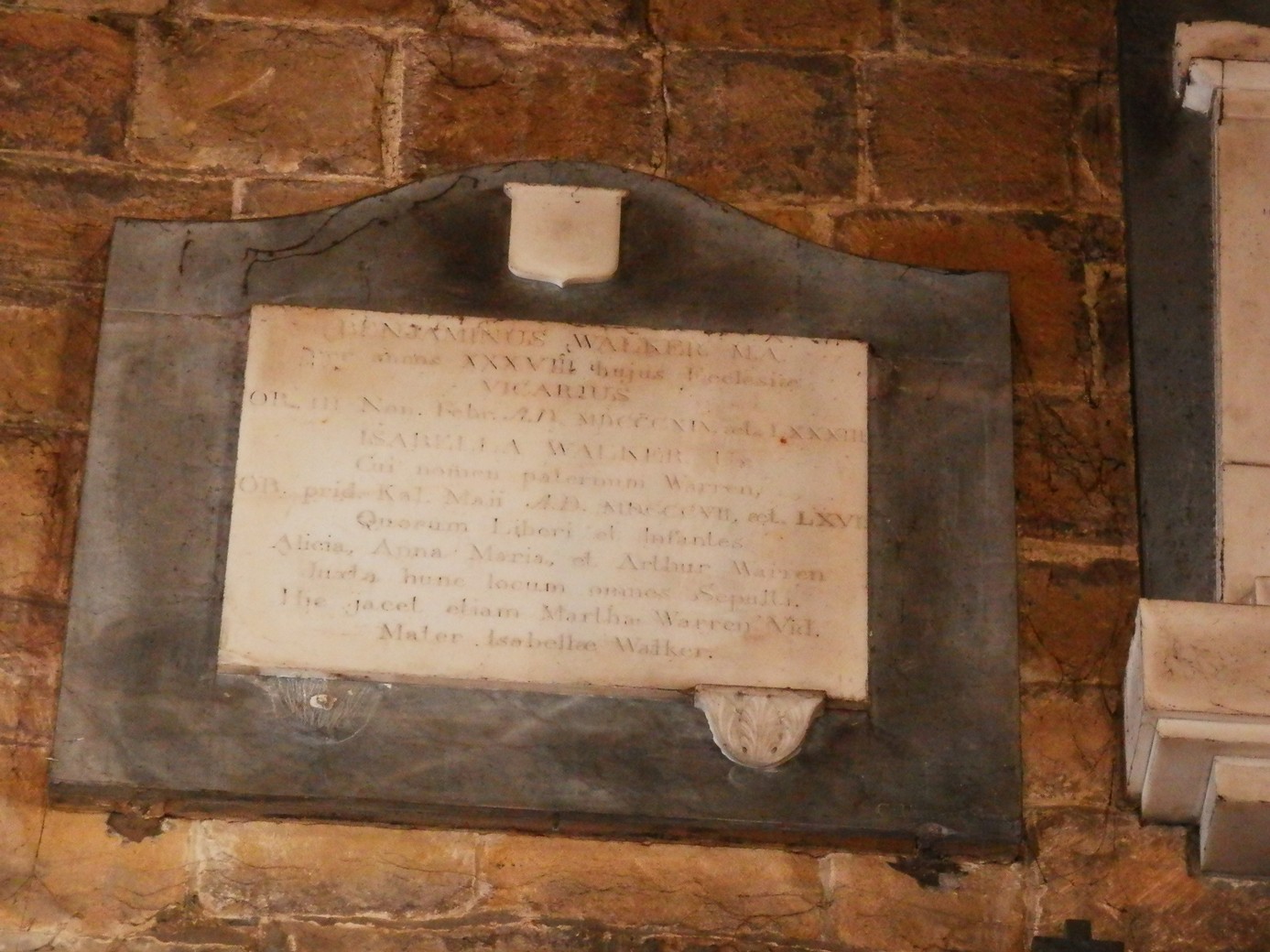
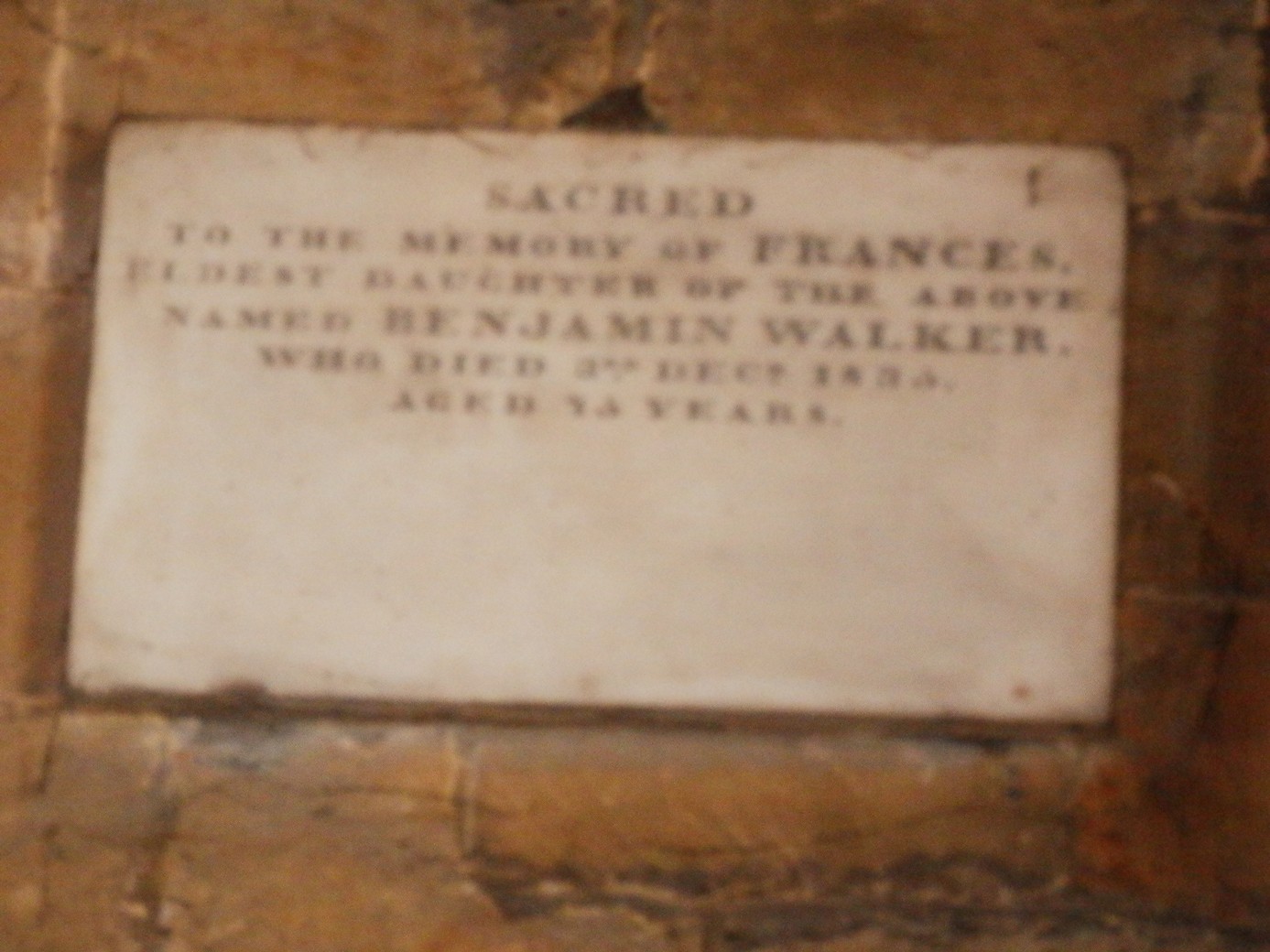
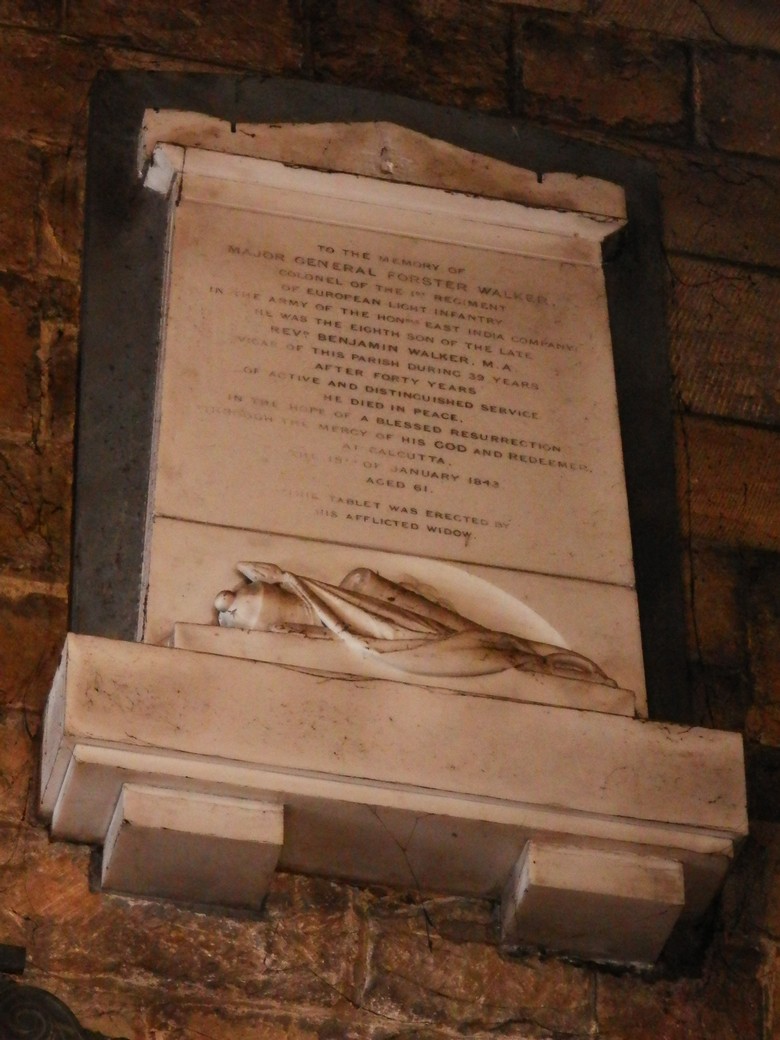
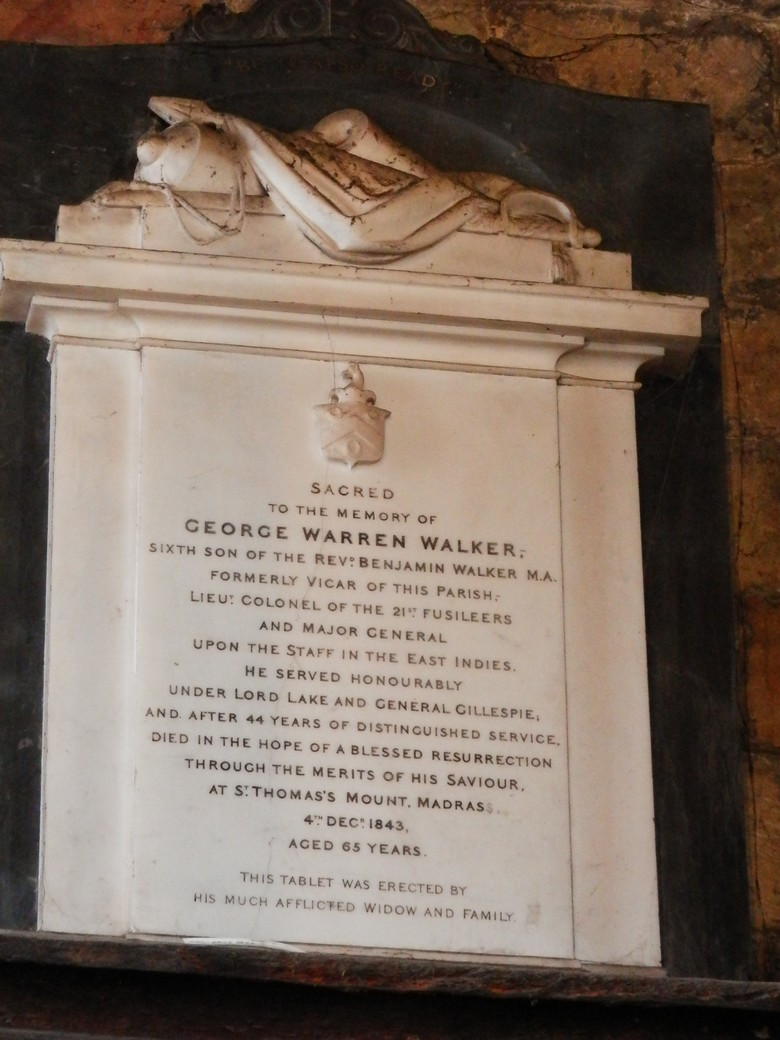
Click image to open viewer window. Use window tools to scroll and enlarge. Click outside window or on X to close.
Forster Walker's wife, Lydia, was a member of the Pattle family. There were marriage connections between the Pattles, the Prinseps and the Thackrays. (William Makepeace Thackray is buried in Kensal Green Cemetery).
Foster Walker's father may have been related to Robert Raikes, founder of the "Sunday School" movement.
The Pattles had been in India for several generations and were well established and quite wealthy.
Lydia Sarah Walker (1803 - 7th December 1864), Forster's wife, was the daughter of Richard William Pattle, (c.1773 - 9th November 1803), born in Bengal and Lydia Penneck Read (1784 - 1852).
Richard had 5 brothers, 3 sisters, 2 half brothers and 2 half sisters.
The most notable of his brothers was James Peter Pattle (24th December 1775 - 4th September 1845). James was a judge and was also described as "the biggest liar in British India". He married Adeline Maria de l'Etang (1793 - 11th November 1845) on 18th February 1811. Adeline had French and Bengali ancestry.
James wished for his body to be sent to England for burial and there are various extraordinary and incompatible stories of what happened his body and the barrel was stored in. Adeline died at sea during the voyage. Some versions of the story say this was because she was shocked by her husband's body suddenly appearing from the broken barrel.
James and Adeline had seven very attractive daughters, many of them born in India, but educated in Paris.
Maria (Mia) married John Jackson. Their daughter, Julia, was the mother of artist Vanessa Bell and writer Virginia Woolf by her second husband, Sir Leslie Stephen. (His first wife was the daughter of William Makepeace Thackray who is also buried in Kensal Green Cemetery).
Sophia (1829 - 1911) married Sir John Warrender Dalrymple (1829 - 1911). The Dalrymples had been in India for several generations and frequently pop up in the history of India and the East India Company. William Dalrymple, the distinguished historian, is a descendant.
There is an excellent website, still being developed as I write this (August 2021) which is devoted to the story of Julia Prinsep Stephen.
There is a passing reference in "The History and Antiquities of North Allerton" that Rev. Benjamin Warren was related to Robert Raikes (14 September 1736 – 5 April 1811), the founder of the Sunday School movement. Raikes was related by marriage to William Wiberforce.
It gets complicated when you try to follow this up.
There is a memorial on the floor of All Saints church: "Robert Raikes. He died 21st March 1709, aged 57."
This Robert Raikes was the father of Robert Raikes (1683 - 1753) who was an M.P. for the borough in 1710. He changed his name to Robert Raikes Fulthorpe after his wife's grandfather, Rev. Christopher Fulthorpe, of Tunstale, Co. Durham. He was succeeded by his son Robert Raikes Fulthorpe, esq. , who died at St. Albans.
However, the Sunday School Robert Raikes was born in Gloucester, son of another Robert Raikes (1690 - 1757) who was the son Timothy Raikes, vicar of Hessle, in the East Riding of Yorkshire, and his wife Sarah. He moved to London at the age of 15.
When I started researching this monument very little was known about Forster Walker. The monument itself was described in an edition of The Builder from 1866 and a summary of that was included in the Historic England listing. The guide "Paths of Glory" by the Friends of Kensal Green Cemetery, was being revised and this memorial was marked out for further research.
Historic England listing entry and map - September 2021
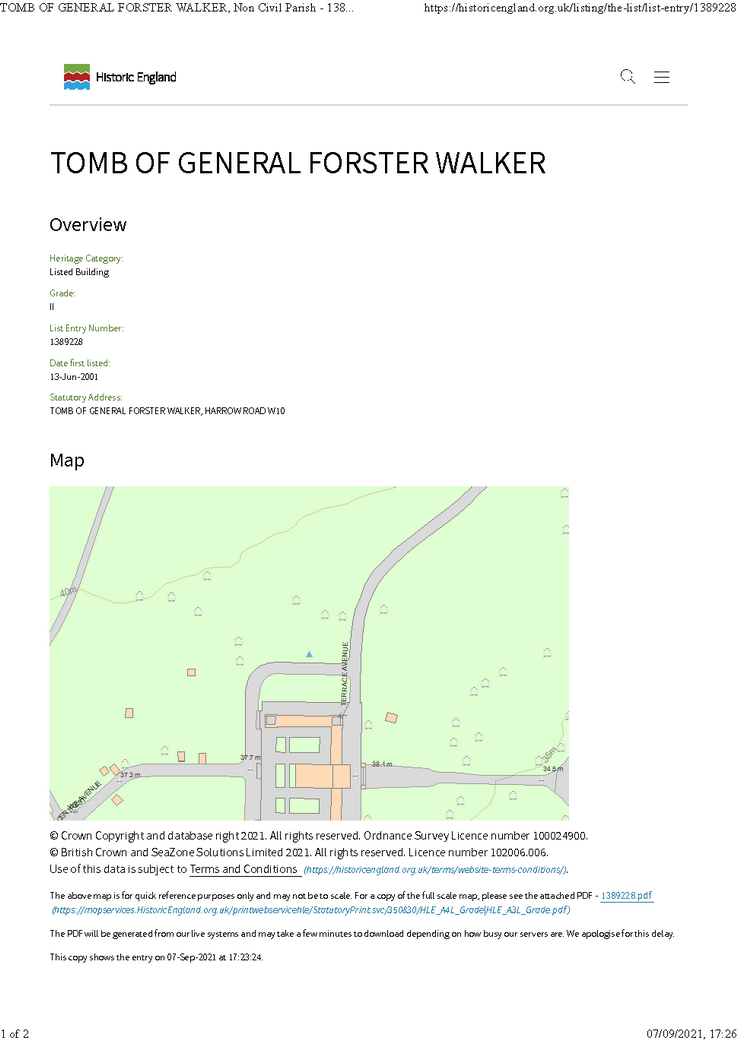
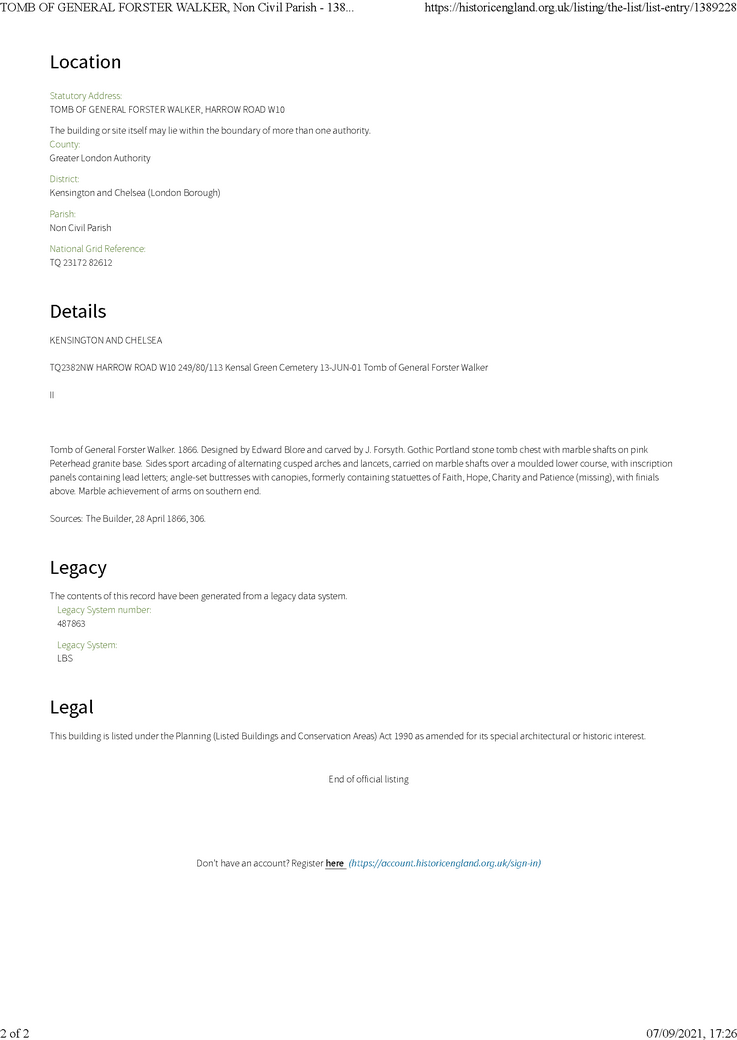
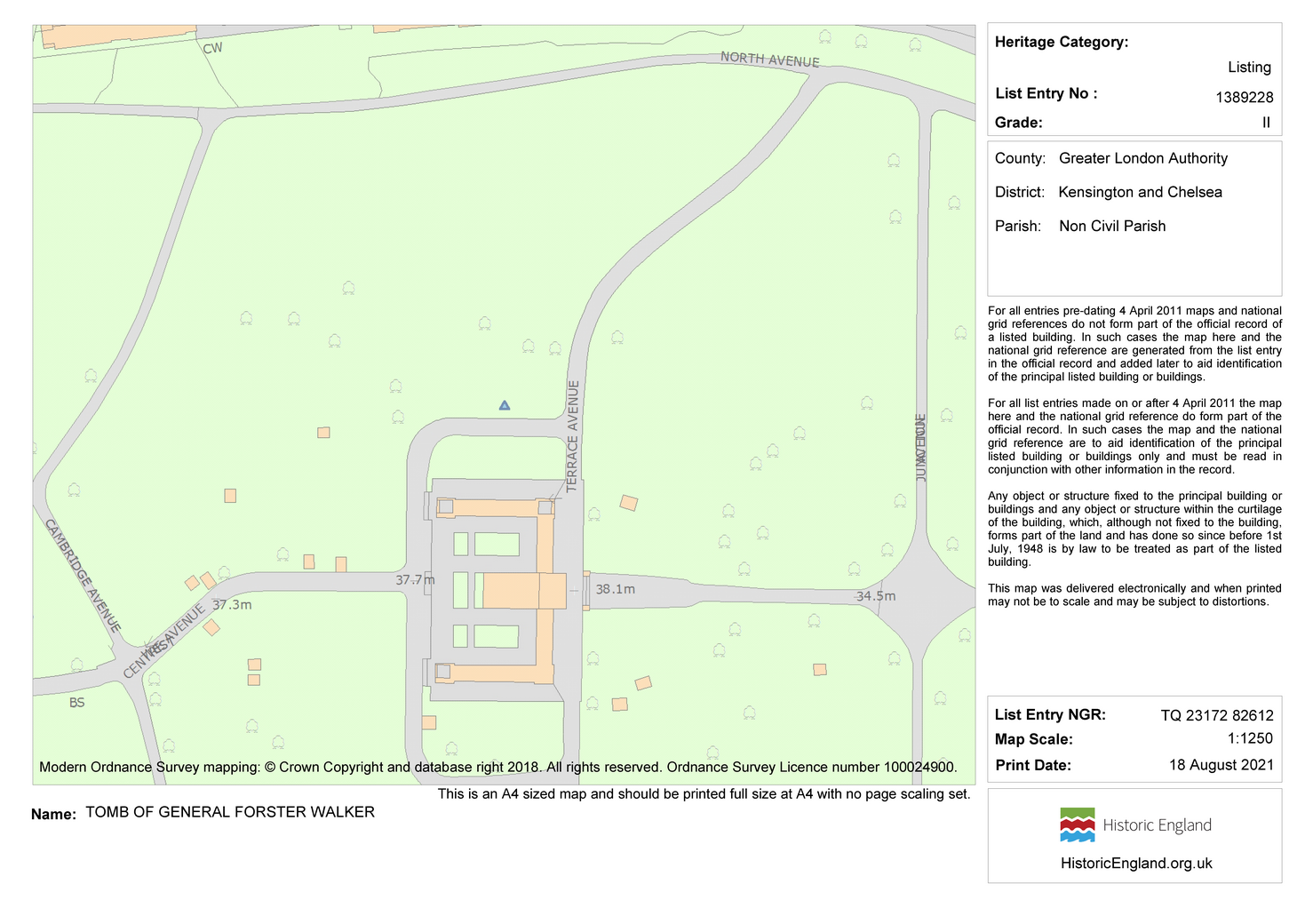
Click image to open viewer window. Use window tools to scroll and enlarge. Click outside window or on X to close.
Extracts from "The Builder" April 28th, 1866
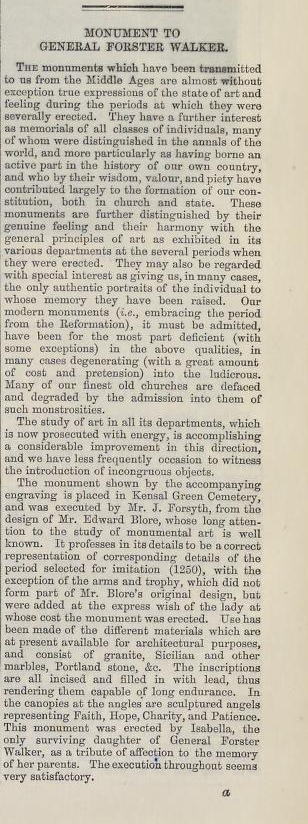
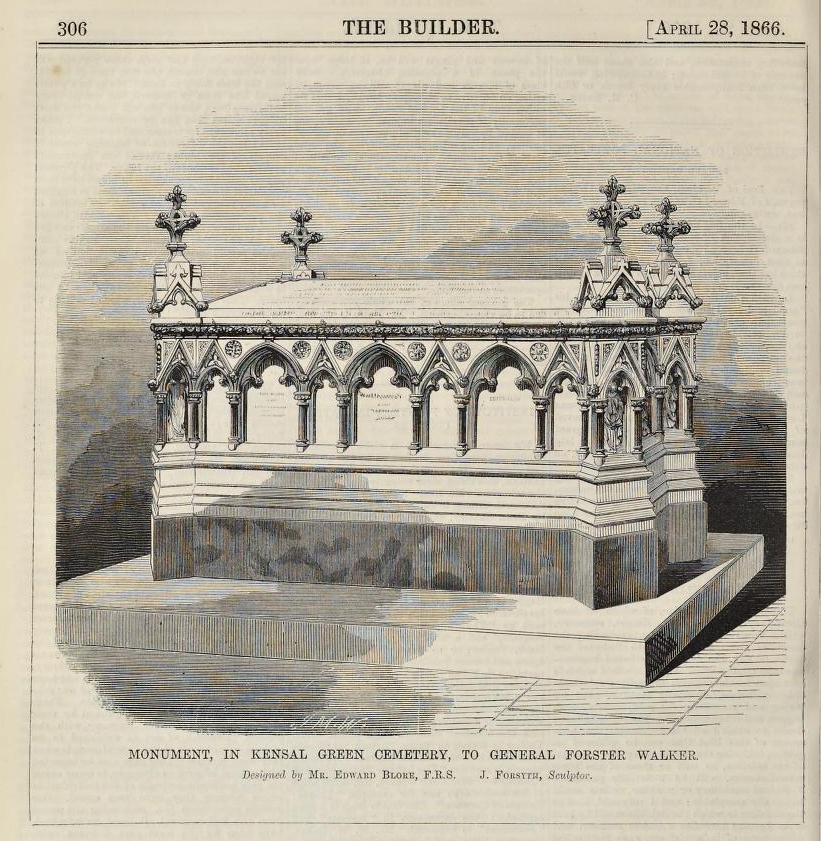
Click image to open viewer window. Use window tools to scroll and enlarge. Click outside window or on X to close.
The first thing I checked was if General Forster Walker was listed in British Army records. This came up blank so it was likely that he was in the East India Company Army.
My primary historical interest is in the Napoleonic Wars so I was a bit out of my depth. I put out an appeal for help on Twitter (I follow and am followed by a number of real historians) and received some valuable pointers (thanks Jacqueline and Rob).
One of the recommendations was to look on Google Books. This turned out to be the richest source of information, see the References section below.
I found a copy of FW's will on the National Archive website, this gave me the name of his wife. A Twitter contact helped me make sense of the ornate handwriting.
I found a copy of FW's will on the National Archive website, this gave me the name of his wife. A Twitter contact helped me make sense of the ornate handwriting.
Gradually I pieced together more and more information. It's a bit like doing a jigsaw, starting at the middle. You don't actually know where the edges are, actualy they can be wherever you want them to be as there is nearly always another lead to pursue.
A note about Google Books
Google Books seems weird.
The amount of access varies, some books are freely downloadable, others can't even be searched. With some, a search throws up a tiny window that cannot be expanded and may not actually show the search hit.
Sometimes a search gets a hit that cannot be duplicated on the downloaded pdf, sometimes it's the other way around.
Searches a few days apart sometimes give different results.
- All my research has been carried out in freely available sections of the Web. I have not used any subscription services, even under a trial period offer.
- I regard memorial inscriptions as the most reliable source.
- Transcriptions of memorial inscriptions can contain errors. I found a document with a hand written ammendment to Forster's name. I would not have found it if I'd not made an error in my search so it's worth trying variants of a name. (Forster, Foster, Forester).
- Genelogical sites with information compiled by non-professionals may have errors. My wife discovered this when looking into he family history. Someone had linked different generations of her family in marriage with the actual spouse as their child!
- Wikipedia should be approached with care.
- Any information should be checked for compatibility with whatever else is known.
- Walker is an annoyingly common name. There was even a ship named Walker making regular calls at Calcutta and the Captain of another ship was called Walker.
- Searching by computer (within Google Books or otherwise) is dependent on the accuracy of optical character recognition. That is extra difficult when dealing with old text styles and old documents. I would probably find more if I read every word myself. Many editions of the Asiatic Journal are over 200 pages!
This is a list of the main sources I have used. Being new to this I have not provided a precise location for each fact stated above, perhaps next time.
Where it is noted that a document is available on Google Books, I have not included a web link. I don't know if these are static; the Google Books search engine should find them without too much problem.
"The Asiatic Journal and Monthly Register for British India and its Dependencies" - January 1816 to December 1829
"The Asiatic Journal and Monthly Register for British and Foreign India, China and Australia" - January 1830 to April 1843
"The Asiatic Journal and Monthly Miscellany" - May 1843 to April 1845
These are all basically the same publication and are available as free pdf downloads from Google Books. It was a monthly publication and is collected into volumes containing 6, later 4, issues.
These contain records such as births, marriages and deaths, promotions, postings and furlough within the EIC, cadet examinations, obituaries, records of sailings and arrivals, prices of commodities, accounts of military actions, articles about local history and culture, and other items of interest.
Probate record of Forster Walker's Will - The National Archive website.
"Alphabetical List of the Officers of the Bengal Army 1834" - Google Books. Gives promotion dates for all those included.
"Bengal Catholic Herald 1841" - Google Books. Brief news item about the assault charge against FW. Details were then found in the Asiatic Journal.
“List of pre-mutiny inscriptions in Christian Burial Grounds in the Patna District” - Google Books. (Not downloadable). This gave me the name of his brother, George Warren Walker.
"The Bengal Obituary" - Google Books. A record of inscriptions on memorials and biograpical notes for some, including FW. (Typescript has "Foster" with hand-written "r" added.)
"The Gentleman's Magazine" - Google Books. Various issues.
"The Protestant Cemetery Catalogue, Rome" - Google Books. Isabell's grave inscription.
"The History and Antiquities of North Allerton" - Google Books. This yielded information about FW's parents and his siblings including baptism dates for those born after 1775.
"The Java Half-Yearly Almanac and Directory for 1815" - Google Books. (Limited search). First indication of presence on Ambon Island.
"British Warships in the Age of Sail 1793-1817" - Google Books. (Limited search), also available on Kindle. For information about brother Benjamin's career.
Genealogy websites - www.geni.com , WikiTree & Ancestry (generally discovered via Google rather than searching site directly).
Find a Grave website - www.findagrave.com (generally discovered via Google rather than searching site directly).
The Gazette - www.thegazette.co.uk British Army promotions (and lots of other stuff).
FIBIs - Families in British India Society www.fibis.org
The Builder archive: http://onlinebooks.library.upenn.edu/webbin/serial?id=builder
Website about the work of the Forsyth brothers - stonemasons. www.theforsythbrothers.com (Note, there is now a page on this site about the Forster Walker monument which contains information I provided.)
Website about Julia Stephens, Virginia Woolf's mother. theelusivejuliastephen.com Information about the Pattles.
Historic England for Listed Buildings.
Wikipedia for the information about FW's brother's wife and plant hunting and some of the historical background. I also discovered the Pattle link when I looked up St. John's Church in Calcutta.